
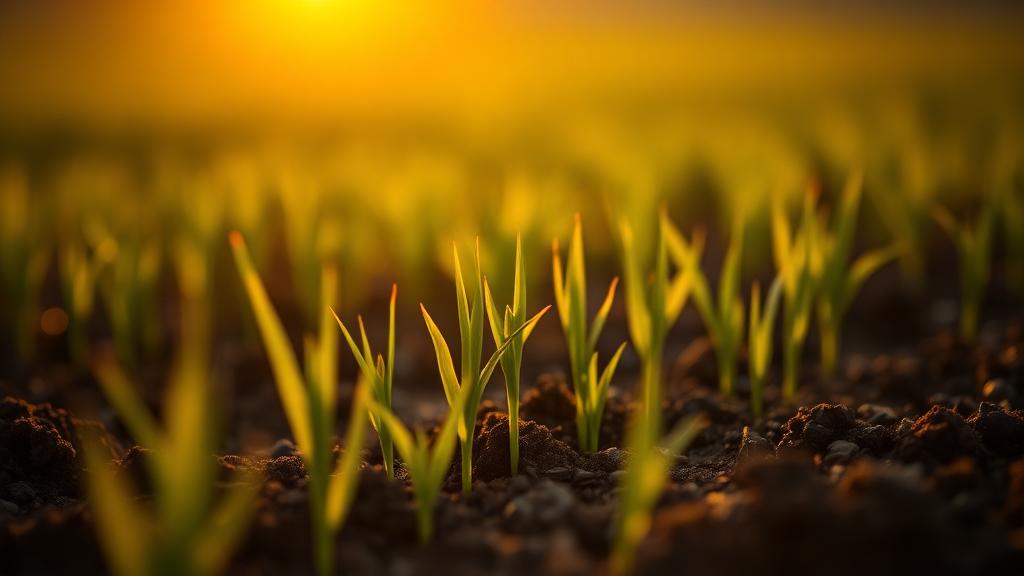
The Farmer Doesn't Make the Seed Grow, A Theology of Waiting Well
Perseverance & WaitingMark 4:26-27
So is the kingdom of God, as if a man should cast seed into the ground; and should sleep, and rise night and day, and the seed should spring and grow up, he knoweth not how.
By Matthew (Tolu) Olowoyeye
Opening: The Question That Wounds in the Silence
There is perhaps no pain in ministry quite as disorienting as the pain of faithful obscurity. It is one thing to suffer for doing wrong. It is an entirely different, and far more confusing, kind of suffering to do everything right and still not see results.
You pray. You fast. You study. You serve. You love your congregation. You preach with everything you have on a Sunday morning to the same twenty faces who were there last week and the week before. And somewhere in the exhaustion of faithfulness, a question begins to form: "What am I doing wrong?"
This teaching is the answer to that question. And the answer, drawn directly from the teaching of Jesus, will surprise you, because it does not begin with a strategy. It begins with a seed.
Part One: What the Parable Actually Says
is one of the most underpreached parables in the Gospels. It is sometimes called the Parable of the Growing Seed, and unlike most of Jesus' parables, this one has no dramatic conflict, no prodigal son, no lost sheep. It is simply this:
A man scatters seed on the ground. He sleeps. He rises. Night and day pass. The seed sprouts and grows, and the man does not know how. The earth produces grain by itself. And when the harvest is ready, he picks up the sickle.
That is the entire parable. And it is one of the most theologically profound things Jesus ever said about ministry.
Notice what the farmer does, and what he does not do:
He does: scatter the seed. Sleep and rise. Trust the process. Show up at harvest time.
He does not: understand the biology of germination. Force the growth. Dig up the seed to check on it. Compare his field to the field next to his.
The core revelation: the farmer's job is sowing and harvesting. Everything in between belongs to God.
Part Two: Three Dangerous Misunderstandings About Church Growth
Misunderstanding 1: Growth is the Minister's Responsibility
"I planted, Apollos watered; but God gave the increase.",
Paul, arguably the most effective church planter in Christian history, made an astonishing admission: the growth of the church was not his achievement. Three different people were involved: Paul who planted, Apollos who watered, and then God, who gave the increase.
The increase was never in Paul's hands. It was never in Apollos' hands. The moment any minister begins to carry the growth of the church as their personal responsibility rather than their faithful stewardship, they have taken on a burden God never assigned them.
Your responsibility is faithfulness. Brilliance in the Word. Depth in prayer. Integrity in character. Love for people. The growth belongs to God. This is not an excuse for laziness, it is a liberation from anxiety.
Misunderstanding 2: Visible Results Equal Effectiveness
, "So shall my word be that goeth forth out of my mouth: it shall not return unto me void, but it shall accomplish that which I please, and it shall prosper in the thing whereto I sent it."
Every seed you have sown is accomplishing something, even if you cannot see it. The Word of God has an internal logic, a germinating power, a capacity to work in the dark that has nothing to do with your observation of it.
Some of your most powerful sermons will never register as powerful in the room. The person who leaves quietly after the service without saying a word may have been the one most profoundly touched. The visiting family that never came back may have taken a seed home that grew into a church in another city.
You do not know the full reach of your faithfulness. And that is not a problem, it is a grace. Because if you knew, pride would follow, and pride would corrupt what God is building through you.
Misunderstanding 3: Small Is Failure
, "For who hath despised the day of small things?"
The context of this verse is remarkable. Zerubbabel is rebuilding the Temple, a project of enormous spiritual significance, and the people are looking at the small beginnings with contempt. God's response is not to accelerate the building. His response is to rebuke the contempt.
Small is not failure. Small is often the seed stage of something enormous. The Church of the New Testament began with 120 people in an upper room. The ministry of Jesus began with twelve imperfect men on the margins of society. Every global movement of God began with a number so small that observers would have considered it negligible.
Never let the smallness of your beginning become the measure of your faithfulness.
Part Three: What a Theology of Waiting Looks Like in Practice
, "And let us not be weary in well doing: for in due season we shall reap, if we faint not."
A theology of waiting well is not passive. It is not resignation. It is not spiritual fatalism. It is active, purposeful faithfulness in the gap between sowing and harvest. It looks like this:
Measure what you can steward. You cannot measure growth directly, but you can measure depth of discipleship, quality of community, frequency of prayer, and excellence of preparation. Focus your metrics on what is yours to steward.
Celebrate underground movement. When someone's prayer life deepens, when a marriage in your congregation stabilises, when a young person makes a decisive spiritual commitment, these are harvest moments, even if they don't register on an attendance chart.
Trust the biology of the Kingdom. says the earth "bringeth forth fruit of herself", the Greek word is automatē, from which we get "automatically." The Kingdom of God has its own germination system. When you have sown faithfully, something is growing that your eyes cannot yet see.
Conclusion: Put Down the Spade
The greatest temptation in the season between sowing and harvest is to dig up the seed to check on it. To keep pulling back the soil of your ministry to see if anything is happening. Every time you dig it up, you disrupt the very process you are desperate to see completed.
Put down the spade. Pick up the watering can. Keep showing up.
Your due season is coming. And when it does, the harvest will be so clearly God's doing that you will have nothing to boast of except His faithfulness, which is exactly how He designed it.
"In the morning sow thy seed, and in the evening withhold not thine hand: for thou knowest not whether shall prosper, either this or that, or whether they both shall be alike good.",
Sign in to like, comment, and follow.
Comments
- Be the first to comment.